Data in the Hands of End Users: How Self-Service BI Empowers End Users at Enexis.
Data Management, Data Vision
The challenge
As is often the case with large organizations, the development of dashboards was highly centralized. As a result, new information needs from the business had to be addressed through central BI teams, which could lead to relatively long turnaround times. Furthermore, BI specialists were not always close enough to day-to-day processes to be able to accurately translate every information need right away.
As a result, end users increasingly began working with data on their own, for example in Excel or using their own Power BI solutions. This brought speed and flexibility, but at the same time created a new problem: different data sources, definitions, and calculations could lead to different versions of the truth.
The challenge, therefore, was to leverage the benefits of self-service BI without losing control over data quality, definitions, governance, and management.
As a result, end users increasingly began working with data on their own, for example in Excel or using their own Power BI solutions. This brought speed and flexibility, but at the same time created a new problem: different data sources, definitions, and calculations could lead to different versions of the truth.
The challenge, therefore, was to leverage the benefits of self-service BI without losing control over data quality, definitions, governance, and management.
Our approach
The solution focused on bringing data, BI, and the business closer together. Instead of developing every information need centrally, users were given more opportunities to create their own analyses and reports within clear guidelines.
The approach included, among other things:
The approach included, among other things:
- Development of custom self-service BI solutions tailored to the needs of specific domains and end users.
- Making reliable and reusable data sources available so that users do not have to collect and combine data themselves every time.
- A clear division of responsibilities between end users and dedicated BI teams: freedom where possible, governance where necessary.
- Working with core data products according to the NBility framework, so that data is standardized and made available in a reusable format for various applications.
- Creating a foundation that allows new dashboards and analyses to be developed more quickly without having to resolve the same data and definition issues over and over again.
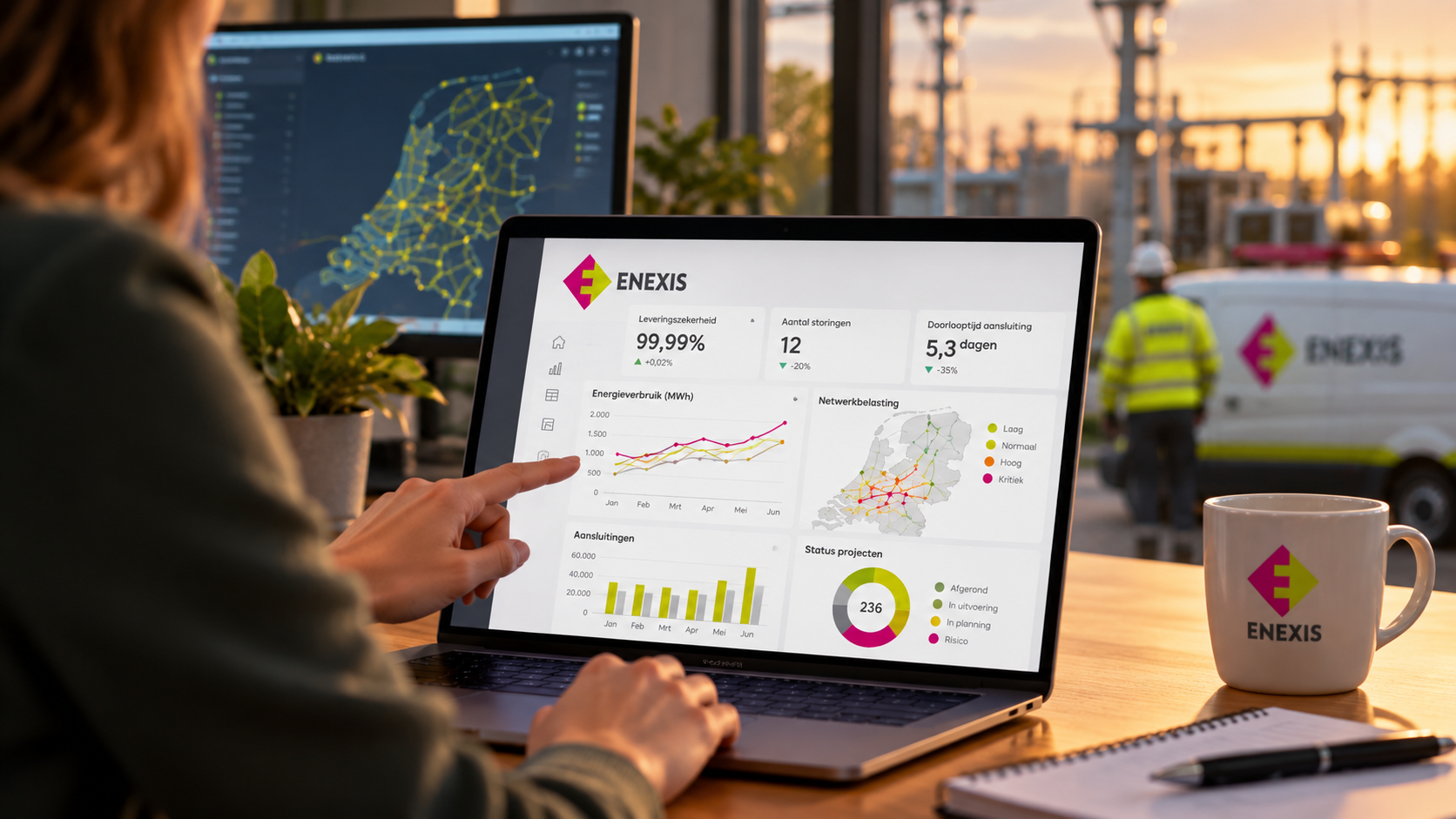
context
Enexis is a large and complex organization that has been shaped over the years in part by various mergers and organizational changes. The organization has traditionally had a strong technical and operational focus, with an emphasis on building, managing, and maintaining energy infrastructure. However, data and IT have taken on an increasingly important role in day-to-day operations and decision-making.
This development created a growing need for reliable and readily available management information. At the same time, there was a disconnect between the central BI organization and the various business and domain teams. The challenge was therefore not only technical: the way data, responsibilities, and knowledge were organized within the organization also had to change.
This development created a growing need for reliable and readily available management information. At the same time, there was a disconnect between the central BI organization and the various business and domain teams. The challenge was therefore not only technical: the way data, responsibilities, and knowledge were organized within the organization also had to change.
The impact
The shift toward self-service BI transformed the role of BI within the organization. BI teams were no longer a bottleneck for every individual information request and were able to focus more on governance, data quality, standards, and complex information products.
At the same time, end users were able to work independently with reliable data. This made insights available more quickly and narrowed the gap between data and day-to-day operations.
The result: shorter turnaround times, greater ownership within the business, reusable data assets, and a stronger data mindset throughout the organization.
At the same time, end users were able to work independently with reliable data. This made insights available more quickly and narrowed the gap between data and day-to-day operations.
The result: shorter turnaround times, greater ownership within the business, reusable data assets, and a stronger data mindset throughout the organization.
Why this case matters
This project demonstrates that self-service BI is about more than just giving end users access to Power BI. Successful self-service BI requires a foundation that brings together reliable data, clear definitions, governance, and ownership.
With this, Enexis took a fundamental step toward data-driven decision-making—not by building yet another dashboard, but by creating an environment in which the business itself can move more quickly from data to insights—without losing sight of a single source of truth.
Isatis business solutions
IBS helps organizations bring data closer to the business. With self-service BI, reliable data foundations, and smart governance, we make data accessible and manageable—so that insights lead to action more quickly.